
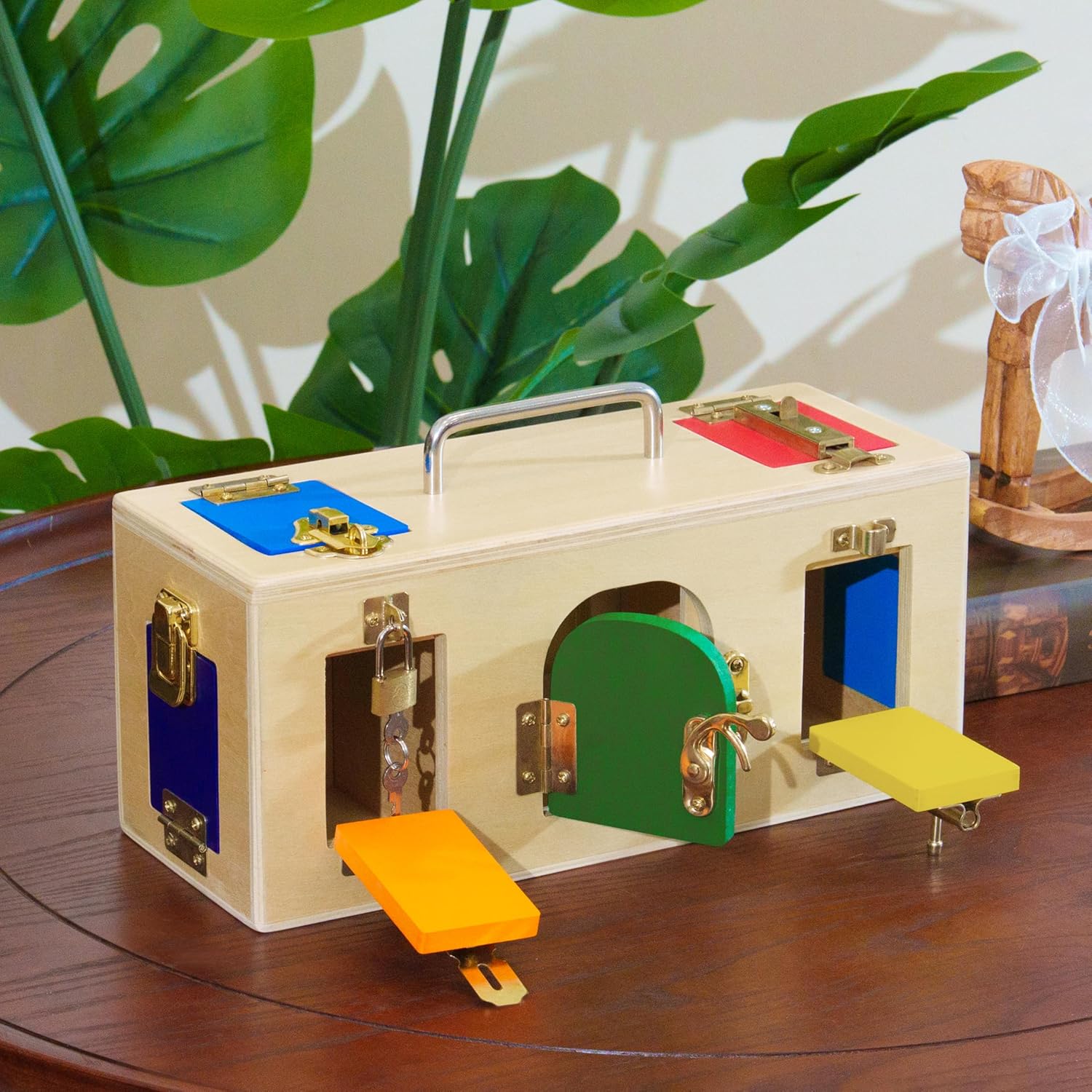
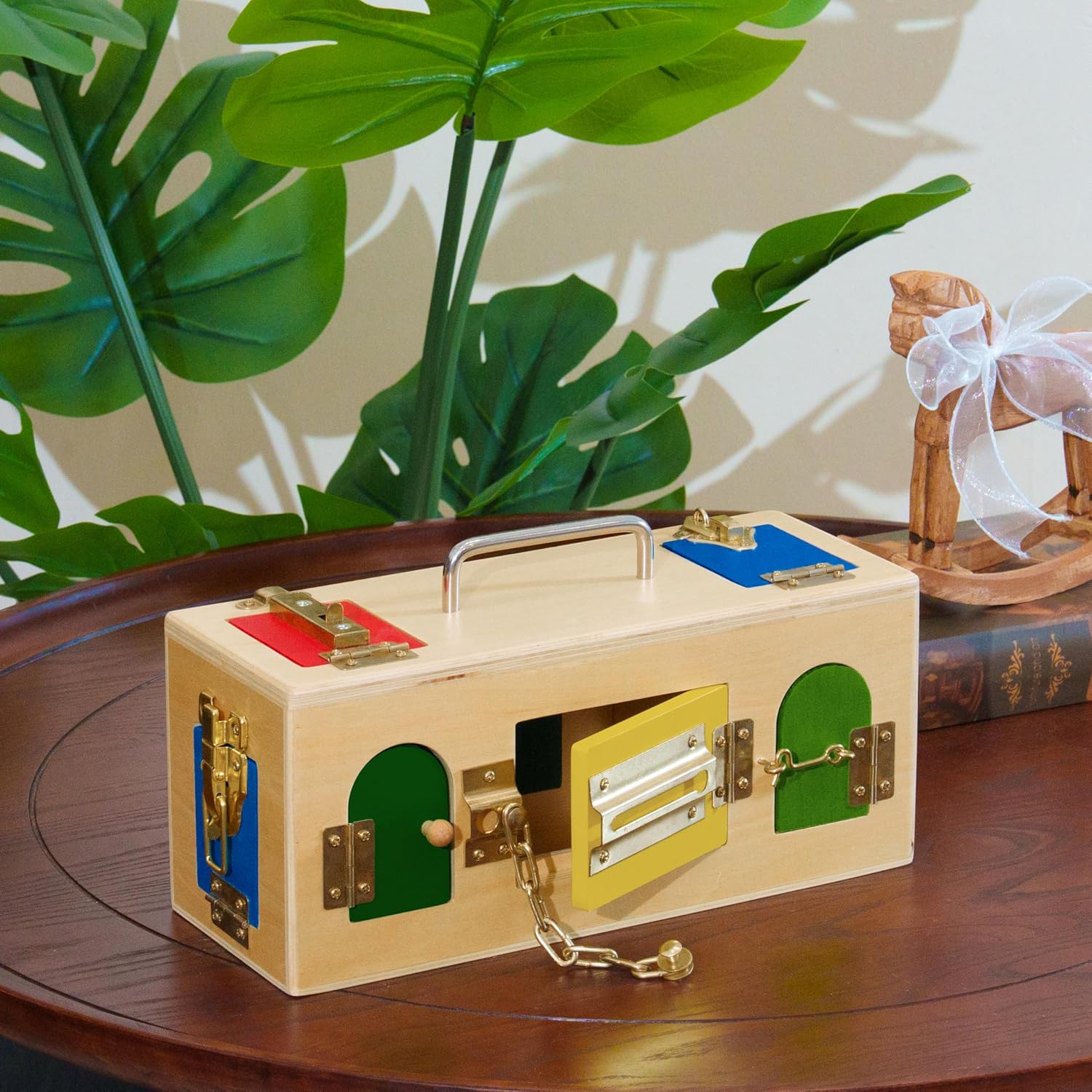
Premium Montessori Lock Box – Wooden Lock Exercises Board, 10-in-1 Practical Life Activity Box with 10 Different Locks & Latches, Fine Motor Skills Toy,Problem Solving, Homeschool Classroom Ages 3-6
Product details
| Management number | 213282732 | Release Date | 2026/04/12 | List Price | $36.00 | Model Number | 213282732 | ||
|---|---|---|---|---|---|---|---|---|---|
| Category | |||||||||
Premium Montessori Lock Box – Wooden Lock Exercises Board, 10-in-1 Practical Life Activity Box with 10 Different Locks & Latches, Fine Motor Skills Toy for Problem Solving & Sensory Exploration, Homeschool Classroom Ages 3-6 Wooden Lock Exercises Board – 10 Locks Complete Practical Life Activity for Ages 3-6 🌿 The Magic of Discovery – Unlocking Learning One Door at a Time In the Montessori practical life curriculum, few materials capture children's imagination like the Lock Box. Ten mysterious doors, each secured by a different lock, hide spaces waiting to be discovered. The child must match the correct key, manipulate the mechanism, and reveal what lies inside – a complete cycle of problem-solving, fine motor work, and joyful discovery. This material is known by many names in Montessori classrooms and educational catalogs: Lock Box, Lock Exercises Board, 10-Lock Busy Box, Lock Activity Box, Montessori Lock Board, Fine Motor Lock Box, Sensory Lock Toy, Practical Life Lock Activity, Preschool Lock Box, Occupational Therapy Lock Board, Multi-Lock Activity Box, and Discovery Lock Box. Whatever its name, its purpose remains – to develop fine motor control, logical thinking, and concentration through purposeful, engaging work. Dr. Maria Montessori observed that children are drawn to real, purposeful activity. The Lock Box provides exactly that – real locks that actually work, real keys that truly open, real compartments to discover. This is work that matters, and children know it. “The child's mind is not a vase to be filled, but a fire to be kindled.” — Dr. Maria Montessori 🔍 Premium Materials – Built for Generations of Hands · Box: High-quality plywood, 34 x 18 x 16 cm (13.4 x 7.1 x 6.3 inches) – substantial and stable · Doors: Ten individual doors with easy-open design for small hands · Locks: Ten distinct mechanisms – including padlock, latch, chain lock, slide bolt, hook lock, key lock, hasp, cam lock, drawer lock, and toggle latch · Keys: Matching keys for appropriate locks, each attached to the box with chains to prevent loss · Weight: 1.35 kg (3 lbs) – heavy enough to stay put during active use · Finish: Smooth, non-toxic, child-safe – meticulously sanded, no sharp edges · Design: Compartments sized for small hands to reach inside 🧠 Complete Learning Outcomes Fine Motor Development: Each lock demands different hand movements – turning a key (wrist rotation), lifting a latch (whole-hand grasp), sliding a bolt (horizontal push), manipulating a chain (bilateral coordination). Together, they prepare the hand for writing and tool use. Problem Solving & Logical Thinking: Children must determine which key opens which lock, sequence their actions (unlock, open, explore, close, lock), and troubleshoot when a key doesn't work. This builds analytical skills essential for mathematics and reading. Cause & Effect Understanding: Each lock creates an immediate result – turn the key, the door opens. This clear cause-effect relationship builds cognitive understanding and prediction skills. One-to-One Correspondence: Matching each key to its specific lock reinforces the concept that each object has a unique match – foundational for counting and early math. Concentration & Focus: The absorbing nature of unlocking and discovering develops sustained attention – a skill that benefits all areas of learning. Memory & Recall: Children remember which lock uses which key and which compartment holds which item, building working memory. Sequencing: The work follows a natural sequence – choose a key, unlock, open, explore, close, lock. Completing this cycle builds understanding of order and process. Independence & Confidence: The self-correcting design allows children to work alone, building self-reliance and the quiet confidence that comes from solving problems independently. 🏡 Classic Montessori Presentations First Presentation – Introducing the Box: Place the lock box on a mat or table. Show the child the ten doors, ten locks, and keys. "This is our lock box. Each lock has its own key." Demonstrate opening one lock slowly and deliberately. Open the door and show the empty compartment. Close the door and secure the lock. Invite the child to try another compartment. Second Presentation – Independent Exploration: After demonstration, invite the child to explore independently. Observe from a distance, allowing them to discover through trial and error. Third Presentation – Matching Keys to Locks: Remove all keys from their locks and place them in a small basket. Invite the child to match each key to its correct lock. Fourth Presentation – Adding Objects: Place small objects (e.g., wooden animals, coins, buttons) in each compartment. The child must unlock, discover, and then return the object before locking – adding memory and responsibility to the work. Extensions: · Time challenges: "Can you open all ten in five minutes?" · Partner work: One child holds keys, another opens locks · Object matching: Pair objects with picture cards · Storytelling: Create stories about what might be in each compartment 🏡 Where This Material Belongs Montessori Homeschool: A core practical life material for ages 3-6. Place on a low shelf for independent work. Children return to it again and again, each time refining their skills. Preschool & Kindergarten Classrooms: Essential for practical life shelves and busy areas. Perfect for individual work, small group collaboration, and transition times. The ten compartments allow multiple children to work together. Special Education & Therapy: Trusted by occupational therapists, autism specialists, and educational therapists. The clear, predictable, tactile nature makes it an effective autism learning resource, fine motor intervention tool, and sensory integration material. Children with attention challenges find the locking/unlocking cycle deeply engaging. Montessori Schools: A staple in primary classrooms worldwide. Used for practical life, sensorial exploration, and fine motor development. Senior Care & Memory Support: The gentle, repetitive activity provides calming cognitive engagement for older adults. Ideal for dementia activities, Alzheimer's therapy tools, and senior cognitive stimulation. Gift Giving: A stunning, heirloom-quality educational gift for birthdays, holidays, or the start of a homeschooling journey. The ten hidden compartments add an element of surprise that children adore. ✨ Why Choose This 10-Lock Box? · Ten Distinct Locks: Maximum variety – padlock, latch, chain lock, slide bolt, hook lock, key lock, hasp, cam lock, drawer lock, toggle latch · Hidden Compartments: Adds surprise and motivation – can be used with small treasures · Keys Attached: No lost keys – keys stay connected to the box · Substantial Size: 34 cm wide – stable and inviting for young children · Sturdy Weight: 3 lbs – stays put during active use · Premium Plywood: Durable, smooth, child-safe finish · Self-Correcting: Each key opens only one lock – built-in control of error · Classroom-Proven: Used in Montessori schools worldwide · Therapist-Approved: Effective for fine motor and cognitive development · Heirloom Quality: Will serve generations of learners “The child who has never learned to act alone, to direct his own actions, to govern his own will, grows into an adult who is easily led and must always lean upon others.” — Dr. Maria Montessori Authentic Montessori Materials – Crafted for Generations.
- 1. 🔒 Complete 10-in-1 Lock Box – Unlock, Discover & Learn: This beautifully crafted wooden activity box features ten different lock mechanisms mounted on sturdy plywood – including padlock, latch, chain lock, slide bolt, hook lock, key lock, hasp, cam lock, drawer lock, and toggle latch. Each lock secures a small door hiding a compartment. Children match keys, manipulate mechanisms, and discover what's inside. Also known as Lock Box, Lock Exercises Board, 10-Lock Busy Box, or Montessori Practical Life Lock Activity.
- 2. 🗝️ “The hands are the instruments of man's intelligence.” – Dr. Maria Montessori: Each lock invites purposeful manipulation. Children develop finger strength, hand-eye coordination, and dexterity as they turn keys, lift latches, and slide bolts. The thrill of unlocking a door and discovering the hidden compartment provides intrinsic motivation and deep satisfaction. This multi-step process – match, unlock, open, discover, close, lock – builds concentration, sequencing, and cognitive flexibility.
- 3. 🧠 What Children Learn – Fine Motor Skills, Problem Solving & Cause-Effect: Through work with this Lock Box (also called Lock Activity Board, 10-Lock Busy Box, or Sensory Lock Toy), children master essential developmental skills. They strengthen hand muscles for writing, develop logical thinking by matching keys to locks, understand cause and effect as each mechanism triggers a door opening, and practice one-to-one correspondence. The ten distinct locks provide graduated challenge – from simple latches to more complex key mechanisms.
- 4. 🏡 Premium Plywood Construction – Built for Generations: This sturdy lock box is precision-crafted from high-quality plywood with smooth, non-toxic, child-safe finish. Features ten compartments with doors, ten different lock mechanisms, and matching keys attached with chains to prevent loss. Dimensions: 34 x 18 x 16 cm (13.4 x 7.1 x 6.3 inches). Total weight: 1.35 kg (3 lbs) – substantial and stable. Meticulously sanded edges ensure safe handling. Designed to withstand decades of classroom and homeschool use.
- 5. 🎁 Essential for Every Learning Environment – Homeschool, Classroom & Beyond: A core Montessori practical life and sensorial material for ages 3-6. Perfect for homeschool curriculum, preschool classrooms, kindergarten busy shelves, and early childhood centers. Ideal for individual work, small group collaboration, and teacher-led presentations. The ten locking doors and hidden compartments make it endlessly engaging. Equally valuable in special education, occupational therapy, autism learning toys, and fine motor intervention. The repetitive work also provides calming for seniors activities.
- 6. 🤝 Self-Correcting & Independence-Building Design: Each key opens only its corresponding lock – built-in control of error. Children discover through trial which key works, building patience and analytical thinking. The hidden compartments provide additional motivation and satisfaction. When finished, children close all doors and secure locks – completing a full work cycle independently. Trusted by Montessori teachers, occupational therapists, and parents worldwide.
| UPC | 677899442558 |
|---|---|
| Color | Lock Exercises |
| Brand Name | penepico |
| Manufacturer | penepico |
| Material Type | Metal, Wood |
| Item Dimensions | 13.4 x 7.1 x 6.3 inches |
| Included Components | Operating Instructions |
| Indoor Outdoor Usage | Indoor |
| Is Assembly Required | No |
| Age Range Description | 3+ years old |
| Educational Objective | 1. Develop fine motor strength and coordination through manipulation of ten distinct lock mechanisms., 2. Build problem-solving and logical thinking skills by matching keys to their corresponding locks., 3. Understand cause and effect relationships as each lock action produces an immediate result., 4. Strengthen hand-eye coordination and sequencing through complete unlock-open-close-lock cycles., 5. Cultivate concentration, independence, and quiet confidence through self-correcting discovery. |
| Manufacturer Part Number | PMST001 |
| Manufacturer Maximum Age MONTHS | 1188 |
| Manufacturer Minimum Age MONTHS | 36.0 |


Bestseller ranking
Play Tools


Correction of product information
If you notice any omissions or errors in the product information on this page, please use the correction request form below.
Correction Request Form